About Petra’s World of Art
Born near Nuremberg and raised in Albrecht Dürer’s city, I was always deeply under the spell of this fascinating artist. During my time at school, I was well-supported in the artistic and socio-political areas and took additional courses in art history and fine arts.
I refined my painting techniques while studying fine art at the Faber-Castell Academy from 2014 to 2018. Influences from informal art have since found their way into my work; I deeply admire Emil Schumacher, Anselm Kiefer, Georges Mathieu, Alberto Burri, and Jackson Pollock.
My international career began in 2019 with an invitation to Art Austria in Vienna and has since taken me and my works to many European cities: Paris, Basel, Barcelona, Madrid, Venice, Rome, Florence, Hamburg, and Salzburg, as well as to New York and Tokyo.
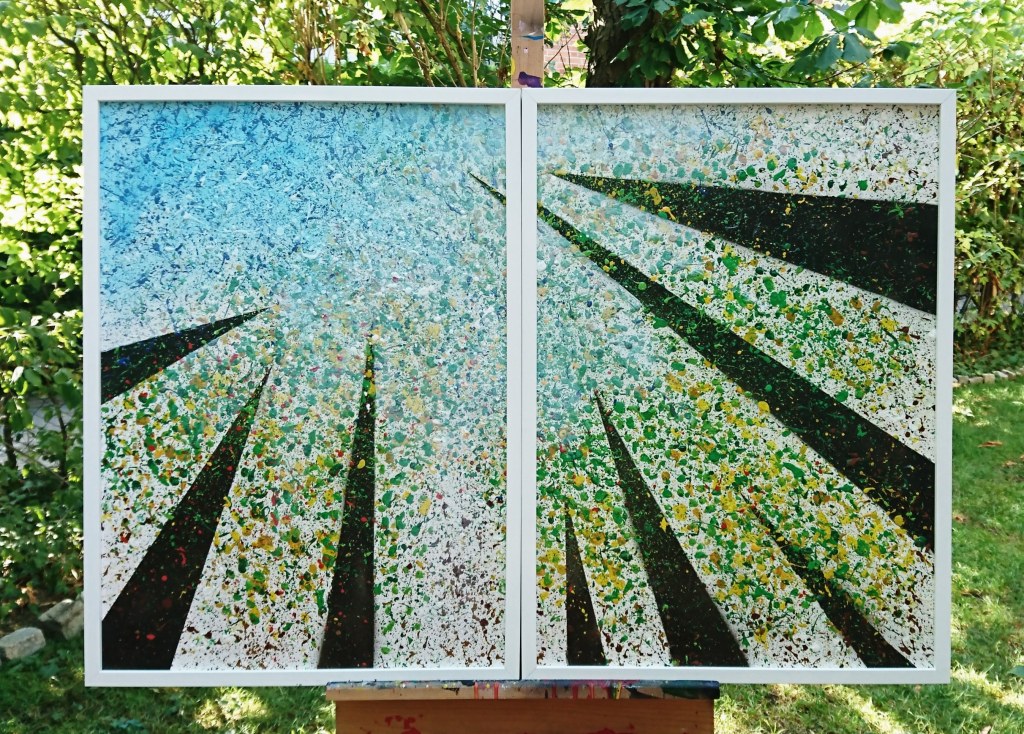
My works are emotional, intuitive, evocative, and passionate. The statements of my works vary: with some pieces, I aim to express a passionate joy in the beauty of life and art and to celebrate this happiness with gratitude. Other works, such as trash art and upcycling art, have a socio-political background. They aim to warn and awaken: the destruction of our planet must be stopped! The pursuit of personal gain must not be placed above the common good! That’s why the invitation to the UBUNTU Trash Art Festival in the summer of 2023 in Burgenland was one of the highlights of my artistic career. I’m overjoyed to be able to showcase my works made from all kinds of trash there again this year and to encourage guests, through workshops, to create something from their waste that prompts reflection.
My greatest wish as an artist is to continue to touch people’s hearts with my works, to critically question our lifestyle, and to appeal to reason and insight.
I agree with Pablo Picasso’s saying: “Painting is not done to decorate apartments; it’s an instrument of war!”
https://www.contemporary-art-collectors.com/art-insights/petra-dippold-goetz-review
https://www.artmarketexperts.com/most-investable-artists/petra-dippold-goetz
Live, love, and fight for what you care about with the WEAPONS of an artist
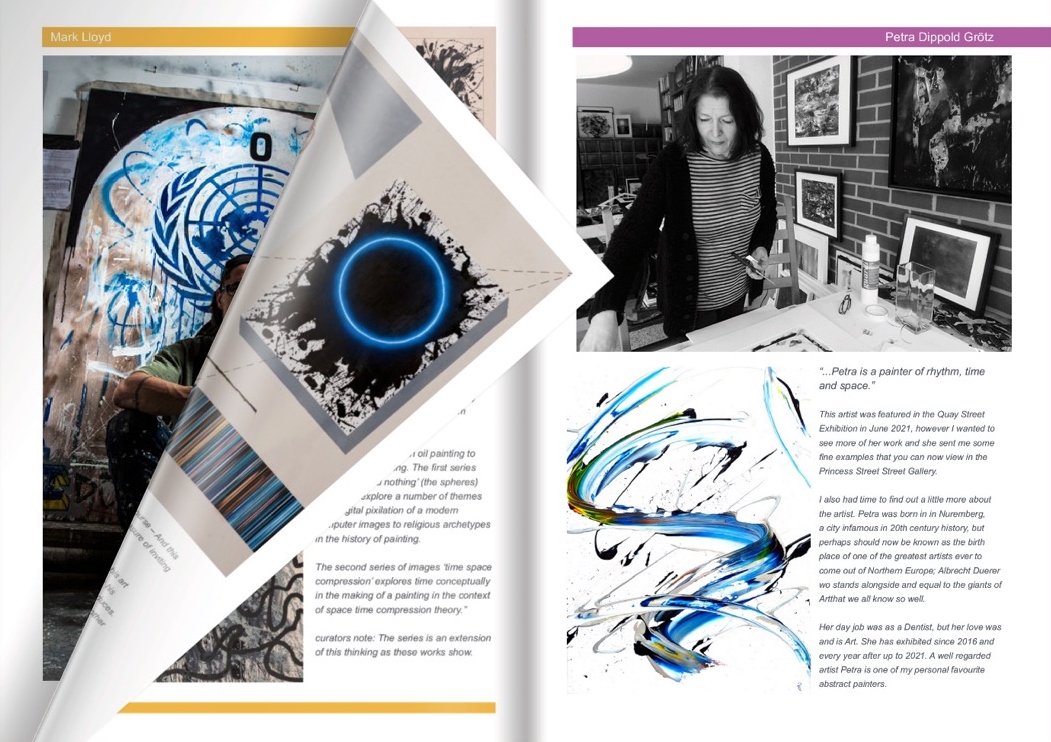
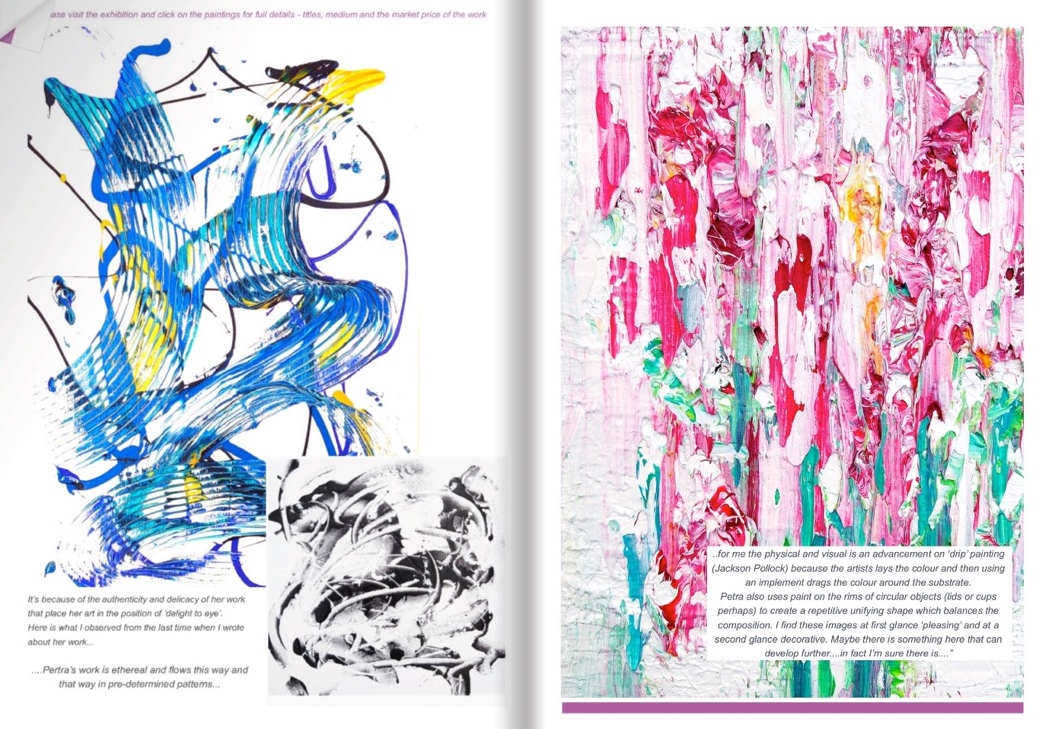
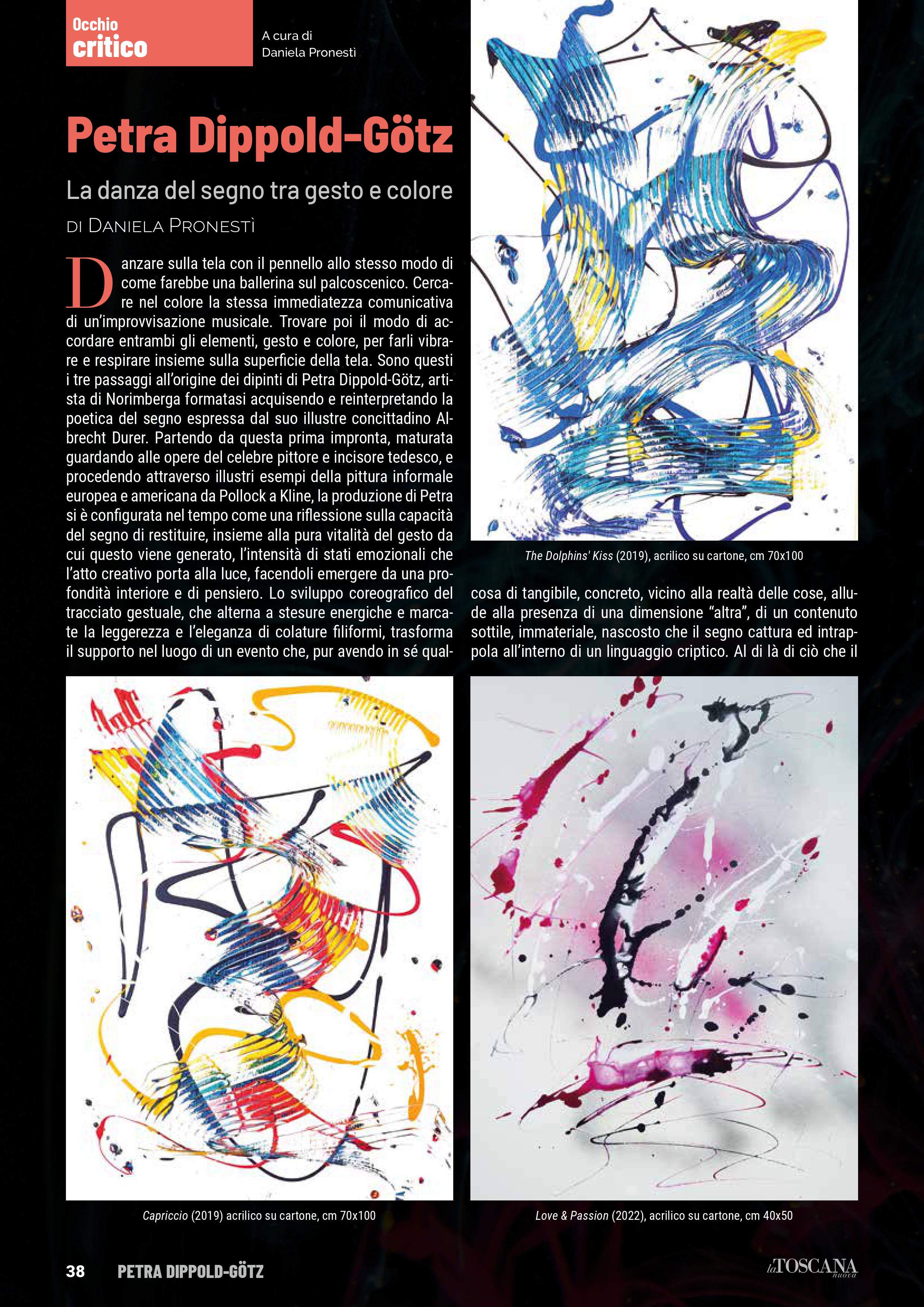
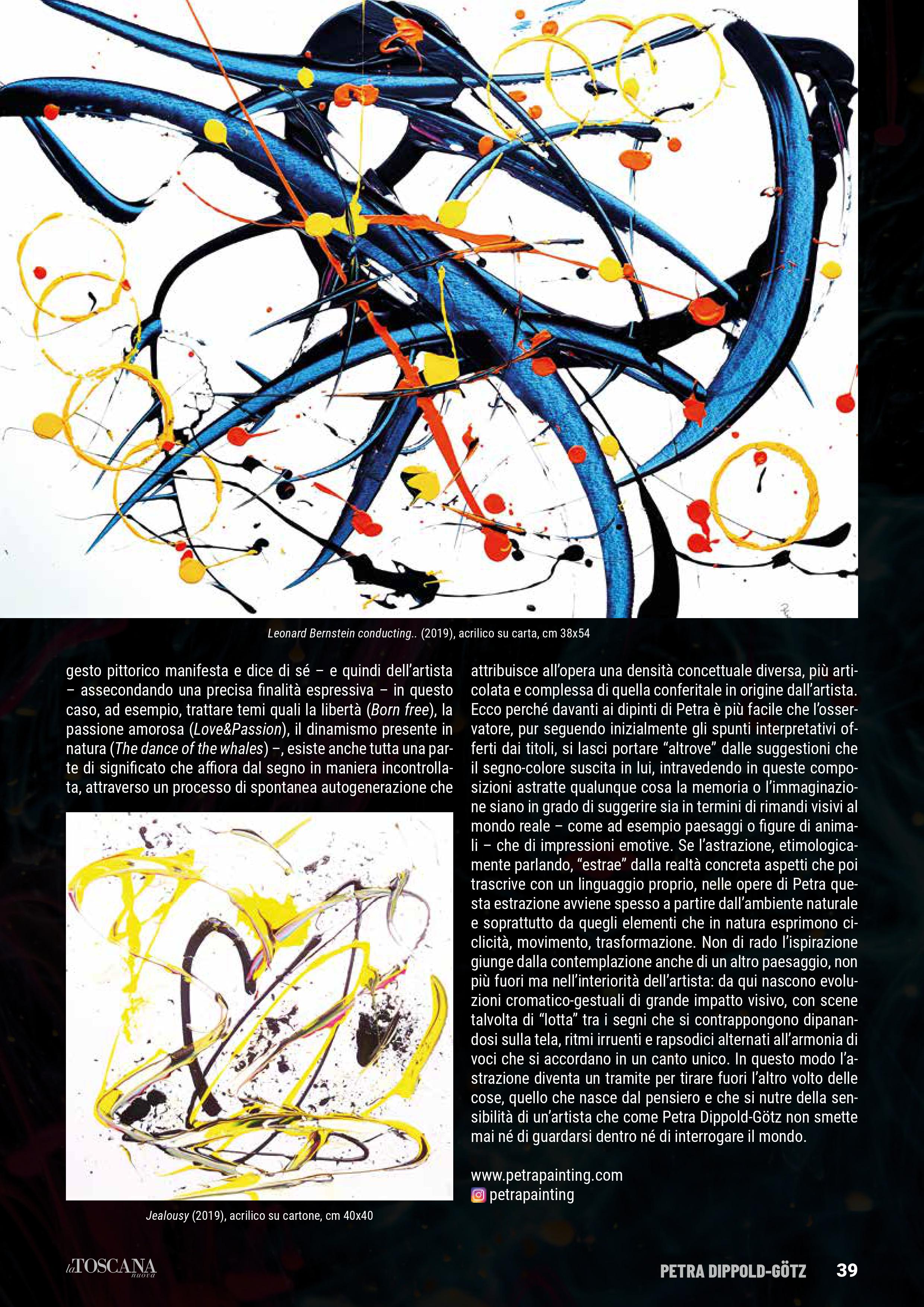
Beyond what the pictorial gesture manifests and says about itself—and therefore about the artist—following a precise expressive aim—in this case, for example, addressing themes such as freedom (Born Free), passionate love (Love & Passion), the dynamism present in nature (The Dance of the Whales)—there is also a whole part of meaning that emerges from the mark uncontrollably, through a process of spontaneous self-generation that gives the work a different conceptual density, more articulated and complex than that initially conferred by the artist.
This is why, when viewing Petra’s paintings, it is more likely that the observer, while initially following the interpretative cues offered by the titles, will be carried “elsewhere” by the suggestions that the sign-color evokes in them, glimpsing in these abstract compositions whatever the memory or imagination can suggest, both in terms of visual references to the real world—such as landscapes or animal figures—and emotional impressions. If abstraction, etymologically speaking, “extracts” from concrete reality aspects that it then transcribes in its own language, in Petra’s works this extraction often starts from the natural environment, especially from those elements in nature that express cyclicity, movement, and transformation.
Inspiration often comes from contemplating another landscape, not outside but within the artist’s interiority: from here arise chromatic-gestural evolutions of great visual impact, with scenes sometimes of “struggle” between opposing marks unfolding on the canvas, with tumultuous and rhapsodic rhythms alternating with the harmony of voices coming together in a unique song. In this way, abstraction becomes a means to bring out the other face of things, the one that arises from thought and is nourished by the sensitivity of an artist like Petra Dippold-Götz, who never ceases to look within herself or to question the world.
Dancing on the canvas with the brush in the same way a ballerina would on stage. Seeking in color the same communicative immediacy as in a musical improvisation. Then finding a way to harmonize both elements, gesture and color, to make them vibrate and breathe together on the surface of the canvas. These are the three steps at the origin of the paintings by Petra Dippold-Götz, an artist from Nuremberg who trained by acquiring and reinterpreting the poetics of the mark expressed by her illustrious fellow citizen, Albrecht Dürer.
Starting from this initial imprint, matured by looking at the works of the famous German painter and engraver, and proceeding through illustrious examples of informal European and American painting from Pollock to Kline, Petra’s production over time has taken shape as a reflection on the ability of the mark to convey, along with the pure vitality of the gesture from which it is generated, the intensity of emotional states that the creative act brings to light, making them emerge from an inner depth and thought.
The choreographic development of the gestural trace, which alternates between energetic and strong strokes and the lightness and elegance of threadlike drips, transforms the support into the site of an event that, while having something tangible, concrete, and close to the reality of things, alludes to the presence of another dimension, of a subtle, immaterial, hidden content that the mark captures and traps within a cryptic language.
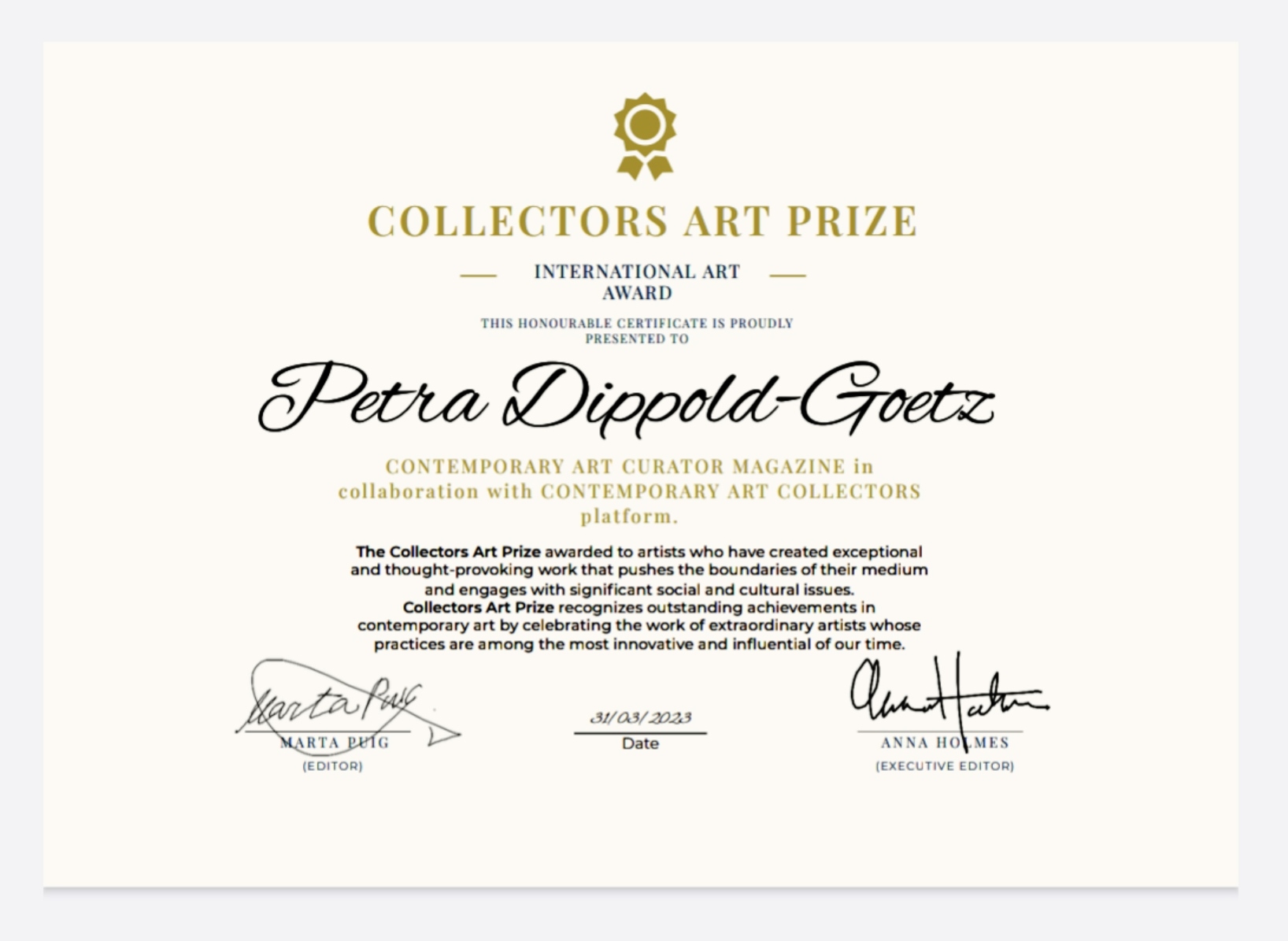
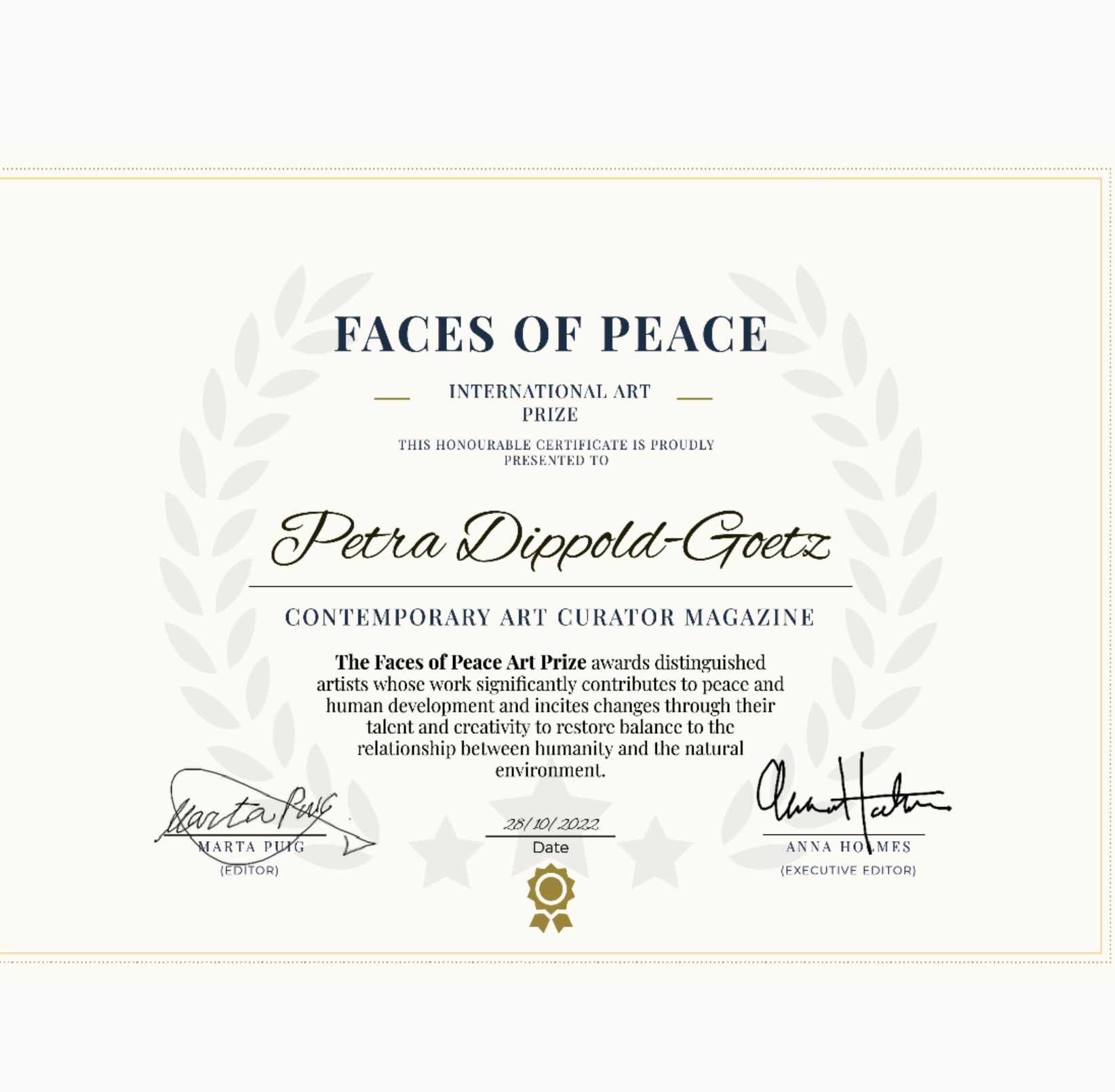
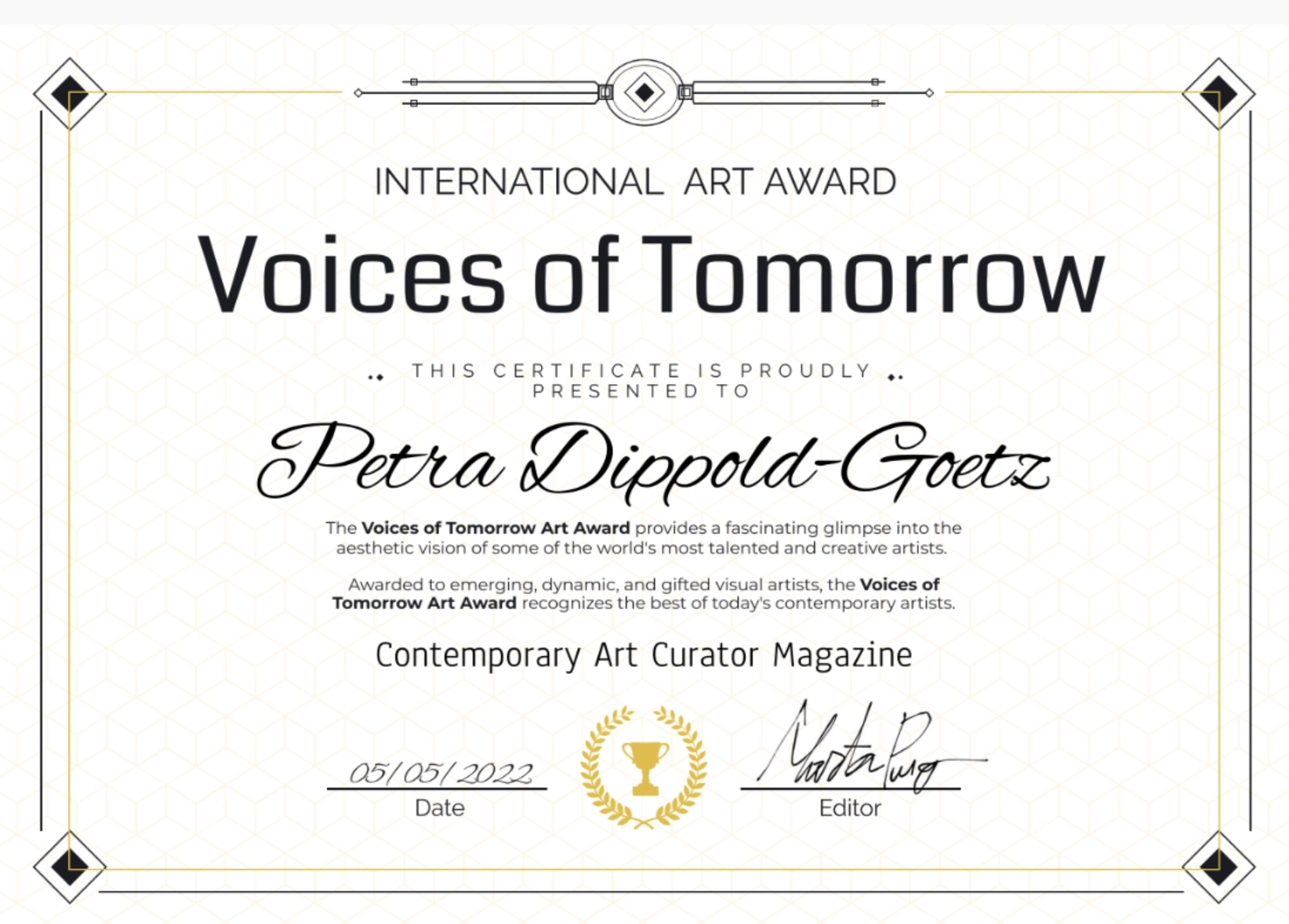
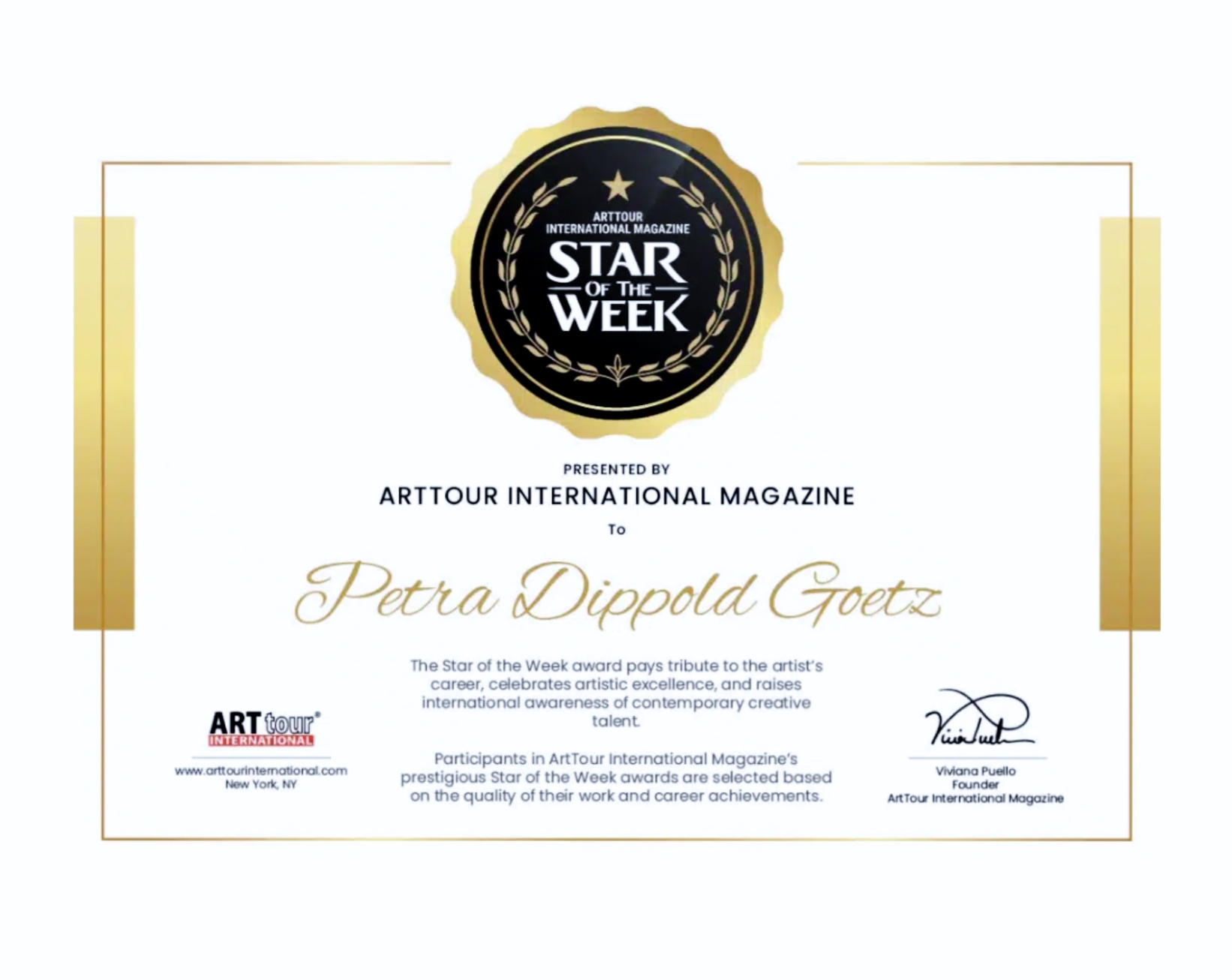
 Petra Dippold-Götz